Transpose a small Excel roster with Paste Special
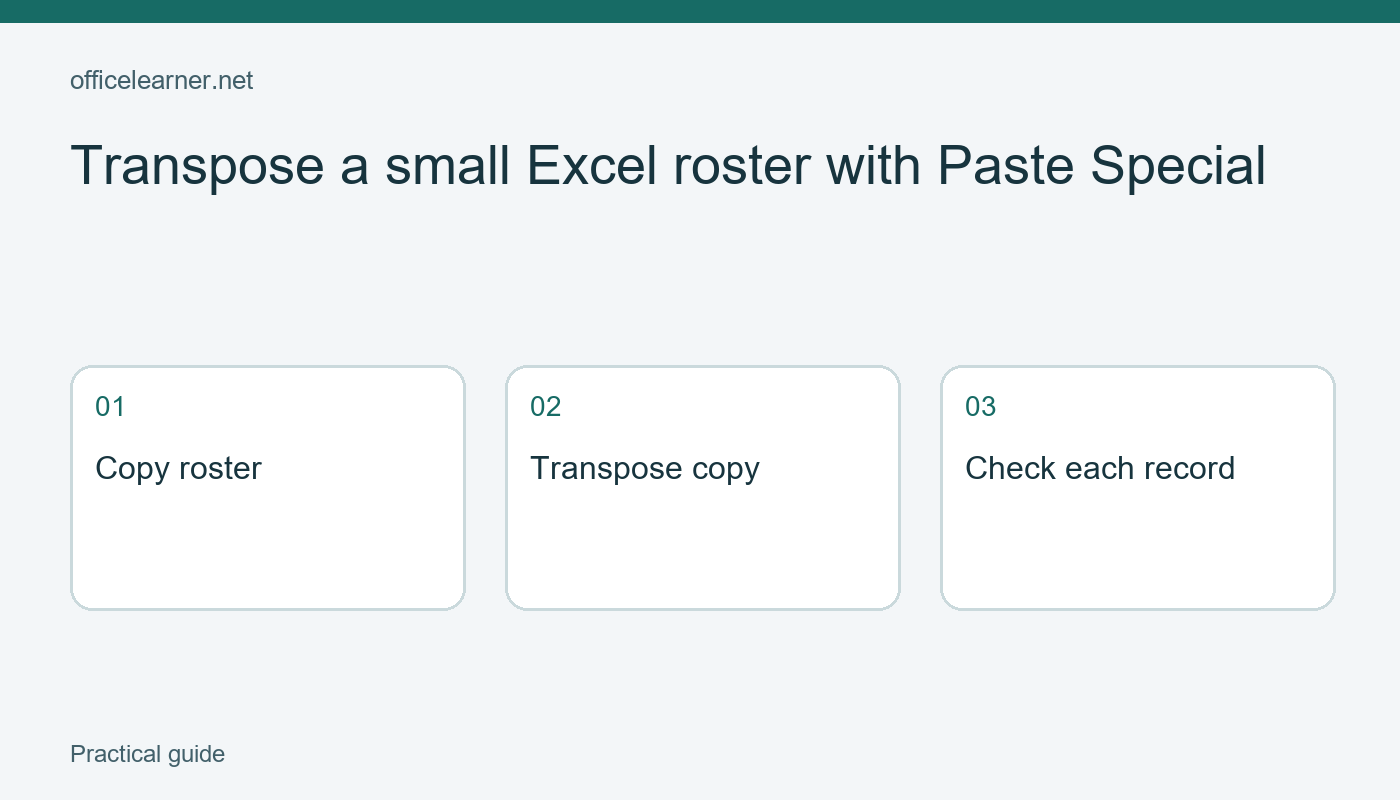
To turn a vertical Excel roster into a horizontal layout, copy the complete rectangle, select an empty destination, and use Paste Special with Transpose. Work on a copy first. This is useful for a small handoff sheet that needs people across the top rather than down the side. It produces a rearranged copy; it is not a promise that later edits to the original roster will update the destination. Decide which layout will be maintained before distributing either version.
Build a practice roster
Open a blank workbook in desktop Excel for Microsoft 365. Put Person in A1, Shift in B1, and Room in C1. Enter Amira, Morning, and Cedar in row 2; Ben, Afternoon, and Maple in row 3; and Chen, Evening, and Birch in row 4. These are fictional assignments for practicing the layout. Keep the original four-by-three rectangle intact. A small example makes it possible to inspect every result rather than trusting an unfamiliar paste operation on a large operational workbook.
Before copying anything, predict the result. The destination will have three rows and four columns because each source row becomes a destination column. Person, Amira, Ben, and Chen will form the first output row. Shift, Morning, Afternoon, and Evening will form the second. Room, Cedar, Maple, and Birch will form the third. Write that prediction beside the example or on paper. It becomes a simple acceptance check and catches an accidentally incomplete selection immediately.
Copy into an empty rectangle
Select A1:C4 and copy it with Ctrl+C. Click E1, leaving a blank column between the original and its rearranged copy. Open Home, the Paste menu, and Paste Special, then select Transpose and confirm. Ribbon labels can vary between Windows and Mac editions, so look for the transpose paste option rather than relying on an icon position. Microsoft's current guidance covers supported desktop releases including Microsoft 365 and Excel 2024. Older installations and browser interfaces may present different options.
The new output should occupy E1:H3. Check H1 for Chen and H3 for Birch. Check F2 for Morning. Those three positions test the far edge, the bottom edge, and an interior item. Finally count the records: the output still contains three people. If only two names appear, undo immediately and inspect whether row 4 was included in the source selection. Do not repair a missing record by typing it into the destination until you understand why it disappeared.
Choose what the handoff should preserve
This practice sheet contains plain text, which keeps the first exercise predictable. A real roster may contain dates, formulas, number formats, comments, and conditional formatting. Copying those features raises separate questions about what the receiving reader actually needs. If the goal is a static snapshot, consider the Values option alongside Transpose in the desktop Paste Special dialog. Verify the available combination in your edition. If the goal is an updating report, a one-time paste is the wrong maintenance plan; investigate a formula-based approach separately.
For an original comparison, change Ben's source shift from Afternoon to Morning after completing the plain-text paste. Look at Ben's output shift. The pasted text should remain Afternoon because a copied text value does not create a continuing link. Undo the source edit so both examples agree again, or label the output with its snapshot date. This exercise explains why two attractive layouts can become contradictory when coworkers assume both are live views of the same information.
Avoid common selection problems
Never paste the transposed result over the original range. The destination has a different shape, and overlapping the source can prevent the operation or risk replacing information. Use a new sheet if you cannot confidently identify a large enough blank area. Check for hidden content below and to the right before pasting. A cell that looks empty at the top of a region does not prove the entire destination rectangle is empty.
If your data is formatted as an Excel table and the transpose option is unavailable, copy the values to a plain practice range and work there first. Do not dismantle an important table merely to rotate a display. Table features and structured references may be part of someone else's workflow. Likewise, merged cells can make selection and paste behavior confusing. A simple unmerged range is the safest starting point for learning, and the original workbook should remain available for comparison.
Review the layout as a reader
Widen the new columns enough to show complete names and room labels. A correct value that is visually clipped is still a poor handoff. Put a descriptive label above or beside each layout so readers know which one is the original and which is the presentation copy. If you plan to print the result, inspect print preview separately. Transposing data does not automatically choose page orientation, page breaks, or repeating print headers for you.
Try a second exercise by adding a fourth fictional person, Dalia, to row 5 of the original. Predict the new destination size before repeating the operation on another empty sheet: three rows and five columns. Check the final name and room, then compare the number of people in both layouts. Which arrangement makes your actual task easier: finding one person's full assignment down a column, or scanning everyone's shift across a row? Keep the layout that serves that task, and document who will maintain it.