Sort a one level Word supply list alphabetically
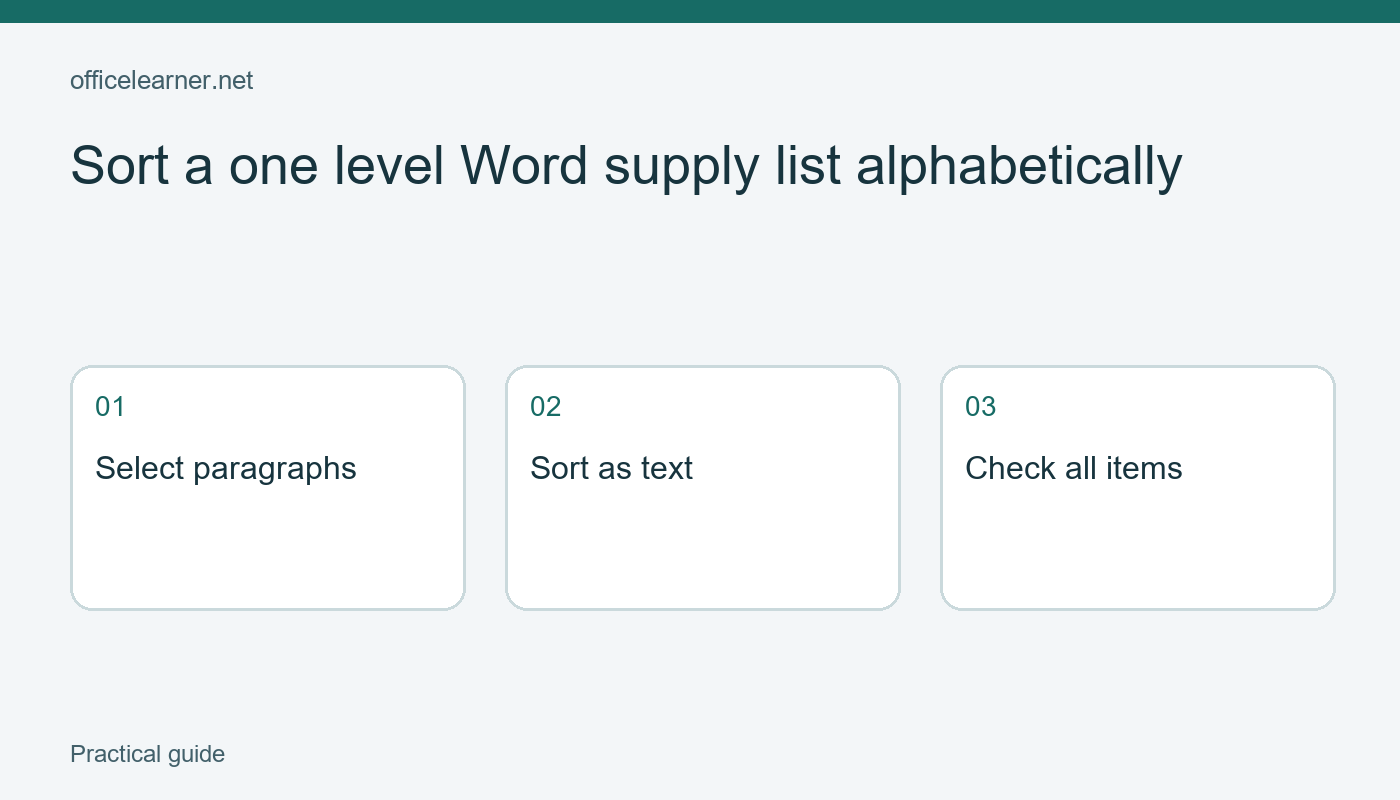
You can alphabetize a simple Word list by selecting its paragraphs and choosing Home, Sort, Paragraphs, Text, and Ascending. Keep the heading outside the selection and check the result before saving. Use desktop Word for this task: Microsoft's guidance says Word for the web can create lists but cannot sort them alphabetically. This tutorial uses a fictional supply list so you can practice without changing a document someone else depends on.
Make a clean practice list
Create a blank document and type Workshop supplies as the heading. Below it, enter Tape, Brushes, Envelopes, Aprons, and Cardboard, each on a separate line made with Enter. Avoid Shift+Enter for this exercise because you want separate paragraphs rather than several displayed lines inside one paragraph. Turn on paragraph marks from the Home ribbon if you need to inspect the structure. The marks help explain what Word considers one sortable item.
Before running the command, write your expected order: Aprons, Brushes, Cardboard, Envelopes, Tape. This gives you a five-item answer key. The original order represents the order in which someone remembered the supplies, whereas the sorted version helps a reader locate a named item. Neither order is universally better. For a procedure, chronological order may matter more than alphabetizing; for a quick reference list, alphabetical order often makes a useful navigation choice.
Select and sort deliberately
Select the five item paragraphs without selecting Workshop supplies. On Home, choose Sort. In the dialog, select Paragraphs under Sort by, Text for the type, and Ascending. Confirm the operation, then read the result from top to bottom. Microsoft's instructions apply to desktop Word for Microsoft 365 and several perpetual releases, including Word 2024. Windows and Mac dialogs may differ in appearance. Follow the option labels rather than assuming that every button occupies the same position.
Compare the result with the answer key. Count five items before and after. Confirm that the heading stayed at the top and did not become a sixth supply. If it moved, undo and make a narrower selection. Undo is also useful if you realize that you accidentally included a following paragraph explaining delivery instructions. It is easier to repeat one deliberate sort than to manually reconstruct text that should never have been part of the list.
Keep each item together
Now replace Tape with Tape for labeling boxes and repeat the sort. The entire paragraph moves as one item, which is what you want. Suppose instead that you put Tape on one paragraph and for labeling boxes on the next. Word can treat those as separate items and separate the explanation from its subject. For a beginner practice document, keep each item and its short description in a single paragraph so the movement stays predictable.
A multilevel outline needs more care. A supply heading with several child bullets is not the same structure as this one-level list. Sorting the entire outline can produce a result that is hard to interpret or maintain. Practice on a duplicate first and inspect every parent and child relationship. If the document contains quantities, suppliers, and notes for each item, a table may be a clearer data structure than several loosely associated paragraphs. Choose the structure before choosing the sorting command.
Decide what counts as the first word
Alphabetical order follows the text you supplied, which may differ from the way a reader mentally groups things. Aprons blue and Blue aprons will occupy different places. Similarly, a product code before a name changes the visible starting characters. Agree on a naming convention before maintaining a shared list. In the workshop example, write the object first and the description second: Aprons blue, Brushes wide, and Tape paper. This makes the list easier to scan consistently.
Do not assume that a software sort resolves editorial questions about names, articles, punctuation, or language. For example, a reading list might intentionally ignore an opening The, while a basic text sort processes the text as entered. Names with accents and lists in different languages deserve a separate review. The practical rule is to inspect a few representative edge cases and document the intended convention. For a small list, human review is faster than designing an elaborate sorting scheme.
Maintain the sorted list
Add Glue after Tape in the practice document. The new paragraph does not automatically move to its alphabetical position merely because the list was previously sorted. Select the item paragraphs and run the sort again, then check that Glue appears between Envelopes and Tape. This is a useful maintenance lesson: a sorted document is a saved arrangement, not necessarily a continuously updating catalog. Someone must repeat the operation after additions or manually insert new items in the correct place.
Before sharing, read the list once for spelling and once for missing supplies. Sorting cannot detect that you forgot scissors, and a typo can place an item somewhere unexpected. Save the practice document under a descriptive name, keeping the unsorted source if it has value. As an exercise, build an eight-item list for a real household or classroom task. Which items need a description to avoid ambiguity? Can another reader find three named supplies quickly without asking how you organized them?