

• About
  • Advertise
  • Privacy & Policy
  • Contact
Office Learner
Advertisement
  • Home
  • Browse by Category
    • Word
      • Word Basics
      • Word Data Entry
      • Word Formatting
      • Word Templates
      • Word Tips
    • Excel
      • Excel Basics
      • Excel Shortcuts
      • Excel Charts
      • Data Validation
      • Conditional Formatting
      • Data Analysis with Excel
      • Dynamic Arrays
      • Advanced Excel Topics
      • Developing Excel Related Tools
      • Essential Excel Books
      • Excel for Accountants
      • Excel for Finance
      • Excel Functions and Formulas
      • Excel Pivot Tables
      • Excel Power BI
      • Excel Power Query
      • Excel Templates
      • Excel Training & Courses
      • Macros and Excel VBA
    • PowerPoint
      • Animation
      • PowerPoint Basics
      • PowerPoint Templates
  • About
  • Office Books
  • Courses
No Result
View All Result
  • Home
  • Browse by Category
    • Word
      • Word Basics
      • Word Data Entry
      • Word Formatting
      • Word Templates
      • Word Tips
    • Excel
      • Excel Basics
      • Excel Shortcuts
      • Excel Charts
      • Data Validation
      • Conditional Formatting
      • Data Analysis with Excel
      • Dynamic Arrays
      • Advanced Excel Topics
      • Developing Excel Related Tools
      • Essential Excel Books
      • Excel for Accountants
      • Excel for Finance
      • Excel Functions and Formulas
      • Excel Pivot Tables
      • Excel Power BI
      • Excel Power Query
      • Excel Templates
      • Excel Training & Courses
      • Macros and Excel VBA
    • PowerPoint
      • Animation
      • PowerPoint Basics
      • PowerPoint Templates
  • About
  • Office Books
  • Courses
No Result
View All Result
Office Learner
No Result
View All Result
Home Excel Advanced Excel Topics

XLOOKUP vs VLOOKUP: The Complete 2025 Comparison (With Examples)

Tanjila Rashid by Tanjila Rashid
May 19, 2026
in Advanced Excel Topics, Excel Functions and Formulas
0
10 Microsoft 365 Copilot Features That Transform Word and Outlook in 2025
0
SHARES
0
VIEWS
Share on FacebookShare on Twitter

If you’ve been using VLOOKUP in Excel for years, it’s time to meet its smarter, more powerful successor: XLOOKUP. Introduced in Excel 2019 and available in Microsoft 365, XLOOKUP fixes nearly every frustration that VLOOKUP users have ever complained about. Here’s a complete breakdown of how they compare — and why you should switch today.

The Quick Summary

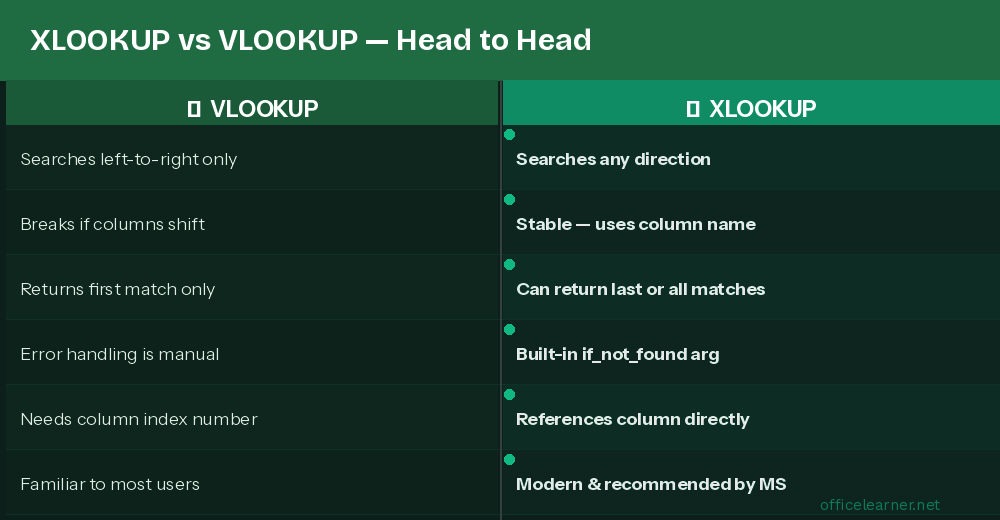
XLOOKUP can search left or right, returns exact matches by default, handles missing values gracefully, and supports arrays natively. VLOOKUP is limited to searching the leftmost column and returning values to its right. For new Excel users, start with XLOOKUP. For existing VLOOKUP users, this guide will make the switch easy.

What Is VLOOKUP?

VLOOKUP (Vertical Lookup) has been an Excel staple since the 1980s. The syntax is:

=VLOOKUP(lookup_value, table_array, col_index_num, [range_lookup])

It searches the first column of a table and returns a value from a column to the right, specified by its number. You must count columns manually, and if your data structure changes, your formula breaks.

What Is XLOOKUP?

XLOOKUP is Microsoft’s modern replacement. The syntax is:

=XLOOKUP(lookup_value, lookup_array, return_array, [if_not_found], [match_mode], [search_mode])

Instead of specifying a whole table and a column number, you specify exactly which column to search and exactly which column to return. This makes formulas far more readable and flexible.
Key Difference #1: Search Direction

VLOOKUP: Can only search the leftmost column of the table array. If you need to look up a value in column C and return a value from column A (to the left), VLOOKUP simply cannot do it — you’d need INDEX/MATCH instead.

XLOOKUP: Can search any column and return any column, regardless of direction. Searching right-to-left is just as easy as left-to-right. This alone eliminates entire categories of complex workarounds.

Example: Find the Employee Name (column A) by searching their ID (column D):

=XLOOKUP(G2, D:D, A:A)

VLOOKUP cannot do this without restructuring your data.

Key Difference #2: Exact Match Default

VLOOKUP: The last argument (range_lookup) defaults to TRUE, meaning approximate match. Forgetting to type FALSE causes wrong results that look correct — one of Excel’s most common and dangerous errors.

=VLOOKUP(A2, B:D, 2, FALSE)  ← You must always add FALSE

XLOOKUP: Defaults to exact match (match_mode = 0). No extra argument needed for the most common use case. Far fewer accidental errors.

=XLOOKUP(A2, B:B, C:C)  ← Exact match by default, clean and simple

Key Difference #3: Handling Missing Values

VLOOKUP: Returns #N/A when no match is found. To handle this, you must wrap it in IFERROR:

=IFERROR(VLOOKUP(A2, B:D, 2, FALSE), "Not Found")

XLOOKUP: Has a built-in [if_not_found] argument (the 4th parameter) that handles missing values natively:

=XLOOKUP(A2, B:B, C:C, "Not Found")

Cleaner, shorter, and less prone to wrapping errors.

Key Difference #4: Column Referencing

VLOOKUP: Requires a column index number (e.g., 3 for the third column). If you insert or delete columns, the number is wrong and results change silently.

XLOOKUP: References columns directly by name or range (e.g., C:C). Inserting columns doesn’t break your formula because you’re referencing the actual column, not counting to it.

Key Difference #5: Multiple Returns

VLOOKUP: Returns a single value only. To return values from multiple columns, you need separate VLOOKUP formulas for each column.

XLOOKUP: Can return an entire row or array in one formula. Specify a multi-column range as the return_array and XLOOKUP spills the results across multiple cells automatically.

=XLOOKUP(A2, B:B, C:E)  ← Returns values from columns C, D, and E in one formula

Key Difference #6: Search Modes

XLOOKUP’s 6th argument lets you control the search direction:

  • 1 (default): First-to-last search
  • -1: Last-to-first search (great for finding the most recent entry)
  • 2: Binary search ascending (faster for large sorted datasets)
  • -2: Binary search descending

VLOOKUP has no equivalent flexibility.

When Should You Still Use VLOOKUP?

Honestly, there are very few reasons to use VLOOKUP in 2025. The only real case is compatibility: if you need your workbook to work in Excel 2016 or earlier, XLOOKUP won’t be available. For everything else, XLOOKUP is strictly better.

Quick Migration Guide

Converting your existing VLOOKUP formulas to XLOOKUP is straightforward:

Old: =VLOOKUP(A2, C:F, 3, FALSE)
New: =XLOOKUP(A2, C:C, E:E, "Not Found")

Replace the table_array and col_index_num with the specific lookup_array and return_array columns. Add your “not found” text as the 4th argument and you’re done.

Final Verdict

XLOOKUP is superior to VLOOKUP in every meaningful way. It searches in any direction, defaults to exact match, handles errors natively, doesn’t break when columns are inserted, and can return multiple columns at once. If you’re on Microsoft 365 or Excel 2019+, there’s no reason to keep writing VLOOKUP formulas. Make the switch today — your future self will thank you.

Previous Post

10 Microsoft 365 Copilot Features That Transform Word and Outlook in 2025

Next Post

How to Use Microsoft Copilot in PowerPoint: Complete 2025 Guide

Tanjila Rashid

Tanjila Rashid

Next Post
10 Microsoft 365 Copilot Features That Transform Word and Outlook in 2025

How to Use Microsoft Copilot in PowerPoint: Complete 2025 Guide

Leave a Reply Cancel reply

Your email address will not be published. Required fields are marked *

I agree to the Terms & Conditions and Privacy Policy.

Stay Connected test

  • 86.2k Followers
  • 23.9k Followers
  • 99 Subscribers
  • Trending
  • Comments
  • Latest
The Evolution of Microsoft Word: A Brief History

The Evolution of Microsoft Word: A Brief History

May 3, 2023

How to Merge and Center Selected Cells in Excel (4 Ways)

February 5, 2023
How to Use Excel SUMIF to Sum Values Greater Than 0

How to Merge Cells in Excel Without Merging Actually

May 3, 2023

How to Create a Weighted Sales Pipeline in Excel

February 5, 2023
Spreadsheet Layout

What is spreadsheet? and how it works!

0
Spreadsheet Layout

Spreadsheet Layout

0
Spreadsheet Layout

IF function of Google Sheets – usage and formula examples

0

5 Google Sheets tricks that you always need!

0
10 Microsoft 365 Copilot Features That Transform Word and Outlook in 2025

8 Hidden Excel Features That Power Users Swear By (2026 Edition)

May 19, 2026
10 Microsoft 365 Copilot Features That Transform Word and Outlook in 2025

10 Outlook Productivity Tricks That Save Hours Every Week (2026)

May 19, 2026
10 Microsoft 365 Copilot Features That Transform Word and Outlook in 2025

How to Use Microsoft Copilot in PowerPoint: Complete 2025 Guide

May 19, 2026
10 Microsoft 365 Copilot Features That Transform Word and Outlook in 2025

XLOOKUP vs VLOOKUP: The Complete 2025 Comparison (With Examples)

May 19, 2026

Recent News

10 Microsoft 365 Copilot Features That Transform Word and Outlook in 2025

8 Hidden Excel Features That Power Users Swear By (2026 Edition)

May 19, 2026
10 Microsoft 365 Copilot Features That Transform Word and Outlook in 2025

10 Outlook Productivity Tricks That Save Hours Every Week (2026)

May 19, 2026
10 Microsoft 365 Copilot Features That Transform Word and Outlook in 2025

How to Use Microsoft Copilot in PowerPoint: Complete 2025 Guide

May 19, 2026
10 Microsoft 365 Copilot Features That Transform Word and Outlook in 2025

XLOOKUP vs VLOOKUP: The Complete 2025 Comparison (With Examples)

May 19, 2026
Office Learner

OfficeLearner is a place where you can learn PowerPoint, Excel, Word Data Analysis, and other Office related programs. We provide tips, how to guide and also provide Excel solutions to your business problems

Follow Us

DMCA.com Protection Status

Browse by Category

  • Advanced Excel Topics
  • Excel
  • Excel Basics
  • Excel Functions and Formulas
  • PowerPoint
  • PowerPoint Basics
  • Uncategorized
  • Word
  • Word Basics
  • Word Tips

Recent News

10 Microsoft 365 Copilot Features That Transform Word and Outlook in 2025

8 Hidden Excel Features That Power Users Swear By (2026 Edition)

May 19, 2026
10 Microsoft 365 Copilot Features That Transform Word and Outlook in 2025

10 Outlook Productivity Tricks That Save Hours Every Week (2026)

May 19, 2026
  • About
  • Advertise
  • Privacy & Policy
  • Contact

© 2022 OfficeLearner - Free Excel, PowerPoint & Word Tutorial & Online Courses

No Result
View All Result

© 2022 OfficeLearner - Free Excel, PowerPoint & Word Tutorial & Online Courses

This website uses cookies. By continuing to use this website you are giving consent to cookies being used. Visit our Privacy and Cookie Policy.