Replace Whole Words in a Word Document Without Changing Longer Words
In desktop Word for Windows, open Home, Replace, expand the search options, and enable Find whole words only before changing a short word that could occur inside longer words. Review replacements individually first. This helps you change a label such as art without accidentally treating part of artist as the same label. A successful replacement is a controlled editing operation, not merely a large replacement count.
Use a duplicate of your document while you learn the options. The example below changes the name of a fictional workshop, and it includes deliberately similar words so you can check the search behavior. The aim is to verify what Word matches before you let it apply the change across a real document with headings, notes, and other content.
Create a sample that exposes the risk
Type these three sentences in a new Word document. The art workshop opens on Monday. Every artist should bring a notebook. The department will display the art project on Friday. The intended edit is to replace the standalone word art with design. The word artist should remain intact. This tiny sample provides an expected result that you can inspect without reading many pages.
Add a fourth sentence: The Art Workshop has a different name on the cover. This gives you a reason to decide whether case matters. A search setting that is appropriate for ordinary prose may be wrong for a product code, legal name, or abbreviation. Make that decision explicitly rather than accepting whatever settings were left over from an earlier search.
Save this practice document. You can use a filename such as workshop-word-replacement-practice.docx. There is no need to include client material, personal data, or a live contract. A small local example is enough to learn how a broad search can differ from the specific change you intend to make.
Review one match before replacing everything
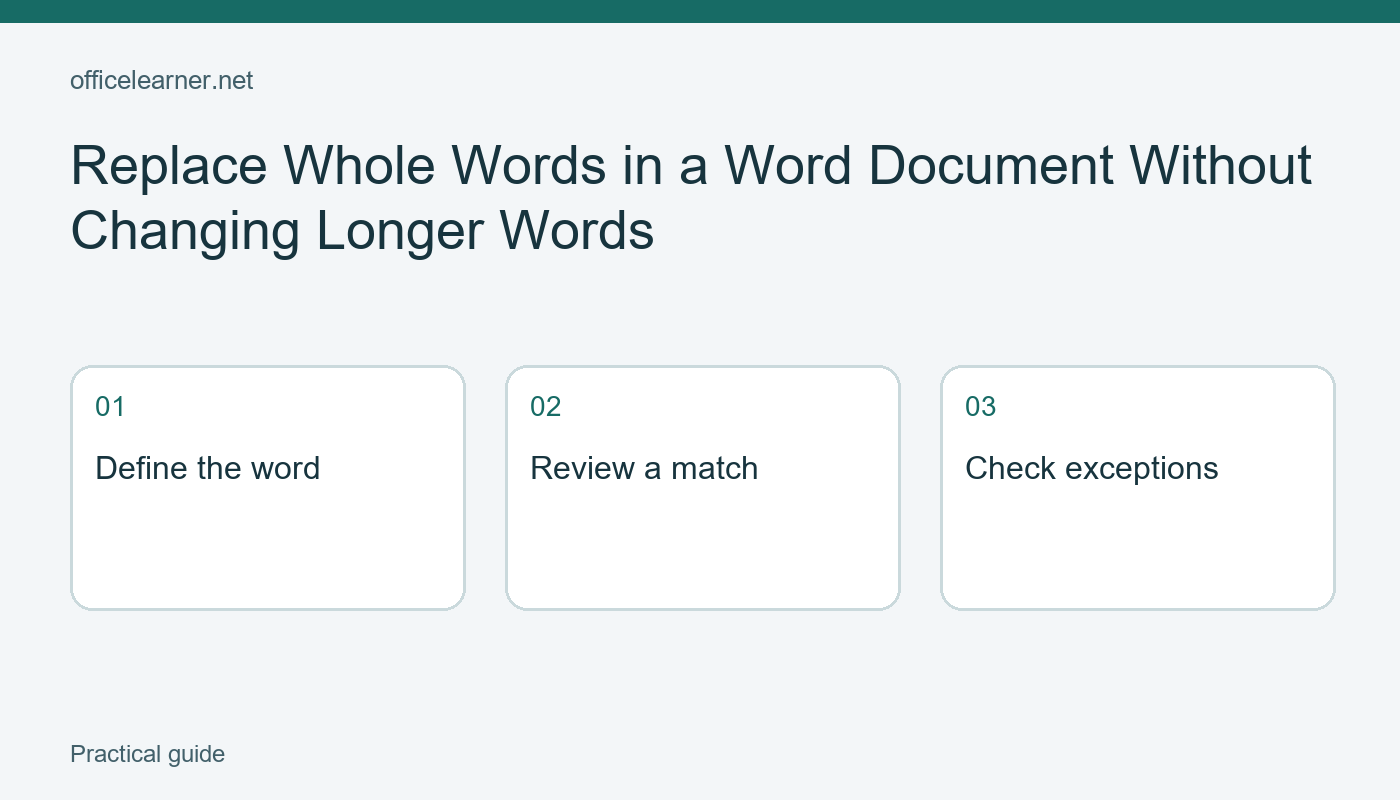
Open Home and select Replace. Enter art in Find what and design in Replace with. Expand More if the advanced options are hidden. Select Find whole words only. Leave Use wildcards off for this exercise. Choose Find Next and inspect the selected text, then choose Replace for the first intended occurrence. Microsoft's Find and Replace instructions recommend reviewing matches when appropriate rather than treating every search as a safe global edit.
Continue through the sample one occurrence at a time. Afterward, read all four sentences. The word artist should still appear exactly as originally written. Decide separately how to capitalize the workshop name on the cover. If you need a case-sensitive operation, use Match case and run clearly defined searches for each form you intend to change.
Whole-word matching does not understand the meaning of a paragraph. It can still find a word in a sentence where the old wording should remain. A quotation, a historical note, or an example of an earlier label may need to be preserved. Search scope and editorial judgment therefore remain important even after the substring problem has been addressed.
Use a short editing checklist for a longer file
Before working through a real report, write down the old term, the new term, and the exceptions. For example, replace a workshop label in current instructions but preserve the original title of a cited publication. That exception is a reason to use Find Next and Replace instead of Replace All. A few minutes of review can prevent a hard-to-detect change in a source title.
Check whether a previous search left formatting restrictions in the dialog. A search limited to a particular font or style can miss otherwise identical words. Remove unwanted formatting constraints before retrying a missing result. If the dialog shows a formatting condition beneath the search field, treat that condition as part of the search rather than assuming the text alone controls it.
When the wording is consistent and every match genuinely needs the change, Replace All can save time. Read the reported count, then search for the old term again. The count is a diagnostic clue, not proof that the edit was correct. Review representative paragraphs, headings, and any places listed in your exceptions. Keep a recoverable original until the review is finished.
Troubleshoot unexpected matches and omissions
If Word finds nothing, confirm that the spelling is exact and that Match case is not excluding a different capitalization. If a longer word changes unexpectedly, undo the change and check that whole-word matching was enabled before the operation. If only a few paragraphs changed, inspect the active selection and any scope prompt before continuing. Avoid repeating Replace All several times while the result remains unexplained.
This walkthrough targets Word for Microsoft 365, Word 2024, and Word 2021 on Windows. The Mac and web interfaces differ, and some advanced search controls may be located elsewhere or unavailable. Microsoft's linked help separates platform instructions. Wildcard searching is a different technique with different matching rules, so keep it outside this basic exercise until the literal-text workflow is familiar.
Finish with a reproducible review
Create a second practice paragraph containing plan, planner, and planning. Replace only the standalone word plan with schedule. Read the result aloud and verify that planner and planning remain unchanged. Then search for schedule to inspect its new context. Which terms in your own documents are short enough to occur inside unrelated words, and which quotations would need an exception before a global edit?